National Socialist Germany: Difference between revisions
m (Text replacement - "\[\[Category(.*)German(.*)\]\]" to "") |
m (Text replacement - "\[\[[a-z][a-z]\:(.*)\]\]" to "") |
||
| (3 intermediate revisions by the same user not shown) | |||
| Line 1: | Line 1: | ||
[[File:Greater German Reich from 1933 on. | [[File:Greater German Reich from 1933 on.png|300px|thumb|right|Greater Germany 1933 - 1945.]] | ||
[[File:Reichsadler Deutsches Reich (1935–1945).png|300px|thumb|right|The ''Reichsadler'' or Emblem of the German Reich (used 1935–1945), which features an eagle looking over its right shoulder, that is, looking to the left from the viewer's point of view. It is similar to the ''Parteiadler'' of the [[NSDAP]], but the eagle of the latter is looking over its left shoulder, that is, looking to the right from the viewer's point of view.]] | [[File:Reichsadler Deutsches Reich (1935–1945).png|300px|thumb|right|The ''Reichsadler'' or Emblem of the German Reich (used 1935–1945), which features an eagle looking over its right shoulder, that is, looking to the left from the viewer's point of view. It is similar to the ''Parteiadler'' of the [[NSDAP]], but the eagle of the latter is looking over its left shoulder, that is, looking to the right from the viewer's point of view.]] | ||
'''National Socialist Germany''', officially '''[[German Reich]]''' (1919–1945), commonly referred to unofficially as the '''Third Reich''' (the first Reich being the [[Holy Roman Empire]], the second being the [[German Empire]]), was governed by the [[National Socialist German Workers Party]] (NSDAP) following their victory as the largest single parliamentary party in the Federal General Elections of 30 January 1933. As a result, during the 1933-45 period [[National Socialism]] became the state ideology. From the [[8 May 1945]] it ceased to exist. | '''National Socialist Germany''', officially '''[[German Reich]]''' (1919–1945), commonly referred to unofficially as the '''Third Reich''' (the first Reich being the [[Holy Roman Empire]], the second being the [[German Empire]]), was governed by the [[National Socialist German Workers Party]] (NSDAP) following their victory as the largest single parliamentary party in the Federal General Elections of 30 January 1933. As a result, during the 1933-45 period [[National Socialism]] became the state ideology. From the [[8 May 1945]] it ceased to exist. | ||
==History== | ==History== | ||
[[File:Co-National Flags of Germany (14 March 1933 to 15 September 1935). | [[File:Co-National Flags of Germany (14 March 1933 to 15 September 1935).png|thumb|300px|Co-National Flags of Germany (14 March 1933 to 15 September 1935)]] | ||
[[File:Karte des Großdeutschen Reiches 1943. | [[File:Karte des Großdeutschen Reiches 1943.png|thumb|300px|The contemporary official designation of the German national state for the period from 1871 to 1945 (map outlined red for the borders from 1 December 1937 and dark green [dashed line] for the borders as of 1943) was ''Deutsches Reich''. It is still used today in political science for this period. In English language publications, the inofficial terms "National Socialist Germany" or even "Nazi Germany" (sometimes ''NS State'') are used. The correct term is ''Deutsches Reich'' and, as of 1943, Greater German Reich (''Großdeutsches Reich''), although this term had been used already since the [[Unification of Germany|unification of the Old Empire]] (''Altreich'') with [[Austria]] (''[[Anschluß]]'') in 1938 (but also including [[Sudetenland]], Memelland and the Free City of [[Danzig]]), including in the official ''Reichsgesetzblatt''. Although the [[Reichstag]] was known as the ''Großdeutscher Reichstag'', only in 1943 was the German Reich officially renamed to "Greater German Reich".]] | ||
===Take-over of power (Machtübernahme)=== | ===Take-over of power (Machtübernahme)=== | ||
| Line 14: | Line 14: | ||
Following the law for the establishment of [exclusion] uniformity between the national and State governments the following was observed at the end of April: all Communists were excluded from sitting; and some diets reduced the number of their seats.<ref>Woodward & Butler, vol.v, 1956, p.46-7.</ref> | Following the law for the establishment of [exclusion] uniformity between the national and State governments the following was observed at the end of April: all Communists were excluded from sitting; and some diets reduced the number of their seats.<ref>Woodward & Butler, vol.v, 1956, p.46-7.</ref> | ||
*In Bavaria [[National Socialists]] and other | *In Bavaria [[National Socialists]] and other fascist parties held 53 seats out of 104. | ||
*In Wurttemberg the Government coalition commanded 29 seats out of 54. | *In Wurttemberg the Government coalition commanded 29 seats out of 54. | ||
*In Baden the National Socialists have an absolute majority (out of 88 seats). | *In Baden the National Socialists have an absolute majority (out of 88 seats). | ||
| Line 23: | Line 23: | ||
*In Mecklenburg-Schwerin the National Socialists hold 24 out of 44 seats. | *In Mecklenburg-Schwerin the National Socialists hold 24 out of 44 seats. | ||
*In Mecklenburg-Strelitz the National Socialists hold 9 out of 15 seats. | *In Mecklenburg-Strelitz the National Socialists hold 9 out of 15 seats. | ||
*In Bremen the National Socialists with other | *In Bremen the National Socialists with other fascists have a majority. | ||
*In Hamburg the National Socialists hold 50 out of 104 seats. | *In Hamburg the National Socialists hold 50 out of 104 seats. | ||
*In the Prussian Diet the National Socialists and other | *In the Prussian Diet the National Socialists and other fascists control 254 seats out of 474. | ||
On 23 October 1933, Germany announced its withdrawal from both the Disarmament Conference (which in any case was a failure) and the [[League of Nations]] in response to the Western powers' refusal to meet its demand for equality between nations.<ref>[https://archive.ph/BTSBH Adolf Hitler, October 14, 1933 Radio Broadcast]</ref> | On 23 October 1933, Germany announced its withdrawal from both the Disarmament Conference (which in any case was a failure) and the [[League of Nations]] in response to the Western powers' refusal to meet its demand for equality between nations.<ref>[https://archive.ph/BTSBH Adolf Hitler, October 14, 1933 Radio Broadcast]</ref> | ||
==The peacetime years== | ==The peacetime years== | ||
[[File:Germany Versailles Treaty, tears up. | [[File:Germany Versailles Treaty, tears up.png|300px|thumb|Germany renounces the hated and imposed [[Treaty of Versailles]].]] | ||
[[File:Map of National Socialist Germany showing its administrative subdivisions (Gaue and Reichsgaue).png|thumb|300px|Map of National Socialist Germany showing its administrative subdivisions (''Gaue'' and ''Reichsgaue'')]] | [[File:Map of National Socialist Germany showing its administrative subdivisions (Gaue and Reichsgaue).png|thumb|300px|Map of National Socialist Germany showing its administrative subdivisions (''Gaue'' and ''Reichsgaue'')]] | ||
The years 1933–1939 under National Socialist leadership showed that Germany could stand strong and independent. First, they succeeded in eradicating unemployment in principle. In 1932, during the [[Weimar Republic]], six million Germans able to work were unemployed. By 1937, over five million of these had found work. Numerous social reforms were implemented in Germany. In addition to better wages, workers also received rights in the event of dismissal, more holidays than in other European countries, better housing standards, health care and more. | The years 1933–1939 under National Socialist leadership showed that Germany could stand strong and independent. First, they succeeded in eradicating unemployment in principle. In 1932, during the [[Weimar Republic]], six million Germans able to work were unemployed. By 1937, over five million of these had found work. Numerous social reforms were implemented in Germany. In addition to better wages, workers also received rights in the event of dismissal, more holidays than in other European countries, better housing standards, health care and more. | ||
| Line 59: | Line 59: | ||
{{main|Organization of the NSDAP}} | {{main|Organization of the NSDAP}} | ||
===The | ===The jewish Question=== | ||
In 1933, Germany had a small | In 1933, Germany had a small jewish population (0.8%) compared to, say, [[Poland]] (10%), [[Lithuania]] (7.6%), Carpatho-Ruthenia (14.1%) and [[Slovakia]] (4.1%) (both then in [[Czechoslovakia]]), Austria (2.8%) and [[Soviet Union|European Russia]] (2.2%). In 1933 there were 503,720 jews in Germany<ref>''Encyclopaedia Britannica Book of the Year 1938'', London, 1938, p.354</ref>, a third of whom lived in [[Berlin]]. | ||
Germany enacted the [[Nuremberg Laws]] on 15 September 1935 at a special meeting of the ''Reichstag'' convened during the annual Nuremberg Rally of the [[National Socialist Party]]. The two laws were the (1) Law for the Protection of German Blood and German Honour, which forbade (a) marriages and extra-marital intercourse between | Germany enacted the [[Nuremberg Laws]] on 15 September 1935 at a special meeting of the ''Reichstag'' convened during the annual Nuremberg Rally of the [[National Socialist Party]]. The two laws were the (1) Law for the Protection of German Blood and German Honour, which forbade (a) marriages and extra-marital intercourse between jews and Germans, and (b) the employment of German females under 45 in jewish households; and (2) the [[Reich]] Citizenship Law, which declared that only those of German or related blood were eligible to be German citizens. Anyone outside these categories were now classed as State subjects without any citizenship rights. A supplementary decree outlining the definition of who was jewish was passed on 14 November, the date the Reich Citizenship Law officially came into force. The laws were expanded on 26 November 1935 to include [[gypsies]] and [[negro]]es. jews in Germany were being actively encouraged to emigrate. Some went to the U.S.A., the most favoured destination. Smaller numbers went to Britain and some others to France and the Low Countries. | ||
In response to the Nuremberg Laws, on 26 August, 1936 the British Embassy in [[Berlin]] compiled a well-researched report and sent it to the Foreign Office in [[London]], stating that "in 1931 out of 3,450 lawyers in Berlin, 1,925 were | In response to the Nuremberg Laws, on 26 August, 1936 the British Embassy in [[Berlin]] compiled a well-researched report and sent it to the Foreign Office in [[London]], stating that "in 1931 out of 3,450 lawyers in Berlin, 1,925 were jews. In [[Breslau]] the numbers were 285 and 192, and in Frankfurt-on-Main 659 and 432 respectively. In Berlin the number of jewish doctors was 52%, while in most towns the average was 30%. Fifteen jewish bankers are stated to have held 718 director-ships in banks and commercial undertakings. Of theatre directors, 50.4% were jews. Although jews formed less than one per cent of the total population, there is a widespread feeling that they blocked the approaches to all the leading positions in the State, monopolising them for themselves."<ref>Medlicott, Professor W.N., Dakin, Professor Douglas, Bennett, Gillian, ''Documents on British Foreign Policy 1919-1939'', Second Series, vol.xvii, HMSO London, 1979, p.175.</ref> | ||
From the 1933 Census until the end of 1937 about 110,000 | From the 1933 Census until the end of 1937 about 110,000 jews had emigrated. In addition there was a natural decrease in this period of about 25,000, leaving about 368,000 in Germany at that point.<ref>''Encyclopaedia Britannica Book of the Year 1938'', London, 1938, p.354</ref>. | ||
In January 1937 a comprehensive report on the | In January 1937 a comprehensive report on the jewish Question in Germany was compiled by Department II/112 of the [[SD]]. It emphasized that rapid jewish emigration from Germany should be the keynote of all efforts regarding the jewish Question. It also recommended the elimination of jews from the economy, a significant increase in political and legal pressure on jews to leave Germany, and the establishment of radically new procedures to further jewish emigration. It continued: "jewish emigration from the territory of the Reich is so urgent that an absolute resoluteness should not be overlooked in the process." In particular, the German government was anxious to get the British Mandate of [[Palestine]] to take more jews than they already had, and the report went on to say its contacts in Palestine must not be involved in: "the stirring up of Arabs against jewish immigrants [which] is harmful to the Reich in the end as it will curtail emigration activity."<ref>Nicosia, Francis R., ''The Third Reich and the Palestine Question'', Tauris & Co., London, 1985, p.151-2, ISBN: 1-85043-010-1</ref> | ||
Between 1919 and 1937, 43,764 | Between 1919 and 1937, 43,764 jews from Germany had arrived in [[Palestine]] (not counting illegals); in 1938 nearly 75% of the comparatively wealthy jews arriving were from Germany; in 1939 fifty percent of all legal immigrants were from Germany. With the outbreak of hostilities in 1939 this figure slumped to 17.4% in 1940, 8% in 1941 and 5% in 1942.<ref>''Great Britain and Palestine 1915-1945'', Royal Institute of International Affairs, Information Papers [Book] No.20, London, 1946. p.66-7.</ref> The emigration procedures established by the [[SD]] in 1938 and 1939 were continued during the first two years of [[WWII]], albeit with diminishing success. In 1939 and 1940 the [[SS]] continued to promote jewish emigration to Palestine, using both legal and illegal channels. These programmes for jews seeking to emigrate to Palestine continued to receive the support of the [[SS]], the Foreign Office, and the Ministry of the Interior. Throughout 1940 and much of 1941 German authorities in eastern Europe did nothing to prevent the steady sometimes chaotic flow of jewish refugees to Palestine and in some cases encouraged it.<ref>Nicosia, 1985, p.163-4.</ref> | ||
On 7 December 1938, the Reich Foreign Minister had a conversation with the French Foreign Minister, George Bonnet, who said great interest was being taken in France for a solution to the ' | On 7 December 1938, the Reich Foreign Minister had a conversation with the French Foreign Minister, George Bonnet, who said great interest was being taken in France for a solution to the 'jewish question'. Bonnet said that in the first place they did not want to receive any more jews from Germany and asked whether Germany could not take some sort of measures to stop them from coming to France any more, and in the second place France had to ship 10,000 jews somewhere else. They were actually thinking of Madagascar for this. Von Ribbentrop replied that "we all wish to get rid of our jews but the difficulties lay in the fact that no country wished to receive them.....and that resettlement of jews was particularly difficult, as they are not willing to undertake any work on the land."<ref>''German Documents on Foreign Policy 1918-1945'' by an editorial board, Series D, vol.iv, p.482-3.</ref> | ||
'''By September 1939, more than 300,000 | '''By September 1939, more than 300,000 jews had left Germany''', and 117,000 from Austria (two-thirds of Austria's jews). Of these, some 95,000 emigrated to the [[United States]]; in the four-month period alone from February 1 to May 31, 1939, 34,000 jews left Germany and 34,300 left Austria.<ref>Nicosia, 1985, p.163.</ref> In addition, there were about 30,000 German jewish refugees held in Britain who were interned in concentration camps on the [[Isle of Man]] and in other locations throughout England and Scotland. A further 8000 were deported to [[Australia]]. | ||
==Terminology== | ==Terminology== | ||
| Line 87: | Line 87: | ||
<gallery widths="150" heights="150" perrow="6"> | <gallery widths="150" heights="150" perrow="6"> | ||
File:800px-Flag of Germany (1935–1945).svg.png|Flag of National Socialist Germany between 1935 and 1945. See also [[swastika]]. | File:800px-Flag of Germany (1935–1945).svg.png|Flag of National Socialist Germany between 1935 and 1945. See also [[swastika]]. | ||
File:German battleship Admiral Scheer. | File:German battleship Admiral Scheer.png|Heavy Cruiser ''Admiral Scheer'' (sometimes called a pocket-battleship) launched April 1933. | ||
File:East Prussia Tannenberg Denkmal from the air. | File:East Prussia Tannenberg Denkmal from the air.png|The [[Tannenberg Memorial|great war memorial and mausoleums at Tannenberg]], [[East Prussia]]. | ||
File:Germany Nuremberg Party Day. | File:Germany Nuremberg Party Day.png|[[NSDAP]] Party Day rally at Nuremberg. | ||
File:Germany Hindenberg airship 1936 colour.png|The huge passenger airship ''Hindenberg'', 1936. | File:Germany Hindenberg airship 1936 colour.png|The huge passenger airship ''Hindenberg'', 1936. | ||
File:Olympics 1936. | File:Olympics 1936.png|The Olympic Games in Berlin, 1936. | ||
File:Germany Versailles Treaty, tears up. | File:Germany Versailles Treaty, tears up.png|Germany breaks free from the chains of the [[Treaty of Versailles]], 30 Jan 1937. | ||
File:Germany MAN ad 1930s. | File:Germany MAN ad 1930s.png|German industry poster advertising heavy trucks. | ||
File:German KdF liner Wilhelm Gustloff in colour. | File:German KdF liner Wilhelm Gustloff in colour.png|New KdF liner ''Wilhelm Gustloff'' at Hamburg. Launched 5 May 1937. | ||
File:German magazine People and Race 1937. | File:German magazine People and Race 1937.png|''People and Race'' magazine, October 1937. | ||
File:Bückeberg Harvest Festival. | File:Bückeberg Harvest Festival.png|Bückeberg Harvest Festival. The 1937 festival was attended by about 1.2 million people. | ||
File:German BDM Our flag flutters before us - Ours is the new time. | File:German BDM Our flag flutters before us - Ours is the new time.png|BDM poster proclaims "Our flag flutters before us - Ours is the new time!" | ||
File:BDM Camp , 1938. | File:BDM Camp , 1938.png|[[Hitler Youth|BDM]] (League of German Maidens) girls in 1938. | ||
File:German HJ Picture. | File:German HJ Picture.png|[[Hitler Youth]] boys cheering. | ||
File:German VWs new2. | File:German VWs new2.png|The launch of the new ''Volkswagon'' (Peoples' car). | ||
File:German Autobahn. | File:German Autobahn.png|Poster advertising the new Autobahns ([https://de.metapedia.org/wiki/Reichsautobahnen ''Reichsautobahnen'']) across Germany. | ||
File:Germany The Land of Music poster. | File:Germany The Land of Music poster.png|"Germany, The Land of Music". | ||
File:Germany Berlin Neuolln Karstadt Dept Store aerial & colour. | File:Germany Berlin Neuolln Karstadt Dept Store aerial & colour.png|The new Karstadt Dept Store with roof gardens, Neukölln, [[Berlin]]. (Destroyed in April 1945) | ||
File:Germany Buildings in the New State (1938). | File:Germany Buildings in the New State (1938).png|Professor Troost's 1938 book, ''Buildings in the New State'' displaying countless new magnificent structures across the country. | ||
File:German new social housing 1938. | File:German new social housing 1938.png|New State social housing. | ||
File:German new social housing flats Munich 1938. | File:German new social housing flats Munich 1938.png|New State social housing: flats in [[Munich]]. | ||
File:German officers and young men poster. | File:German officers and young men poster.png|Poster encouraging [[Hitler Youth]] boys to join the forces. | ||
File:Germany 1938-9. | File:Germany 1938-9.png|Map of Greater Germany following the union with [[Austria]], cession of [[Sudetenland]], and assumption of the [[Protectorate of Bohemia and Moravia]] 1938-9. | ||
File:Adolf Hitler addresses to the Reichstag, 1941. | File:Adolf Hitler addresses to the Reichstag, 1941.png|The German Chancellor addresses the Reichstag, 1941. | ||
</gallery> | </gallery> | ||
| Line 149: | Line 149: | ||
[[Category:National Socialism| ]] | [[Category:National Socialism| ]] | ||
Latest revision as of 21:05, 28 February 2024
National Socialist Germany, officially German Reich (1919–1945), commonly referred to unofficially as the Third Reich (the first Reich being the Holy Roman Empire, the second being the German Empire), was governed by the National Socialist German Workers Party (NSDAP) following their victory as the largest single parliamentary party in the Federal General Elections of 30 January 1933. As a result, during the 1933-45 period National Socialism became the state ideology. From the 8 May 1945 it ceased to exist.
History
Take-over of power (Machtübernahme)
A further Federal General Election was held on 5 March 1933 again giving the National Socialists the largest number of seats (288) in the Reichstag. Hitler stated in a Cabinet Council that his successes in Bavaria in particular had exceeded his wildest dreams".[1] The next large bloc was held by the Marxist Social Democratic Party of Germany (SDP) (120). The Communist Party of Germany (KPD) held 81. Under the provisions of Reichspräsident Paul von Hindenburg's Reichstag Fire Decree[2] all the Communist deputies were arrested, and several Social Democrats were kept out of the chamber. On March 6 the Communist Party was banned.[3] In June the SDP also was banned altogether from operating in any way in Germany.
Following the Reichstag fire on Monday 27 February 1933, the parliament moved across the Königsplatz square (today Platz der Republik) to the magnificent Kroll Opera House, facing the Reichstag building. (It was bombed by the British RAF on 22 November 1943.)
Following the law for the establishment of [exclusion] uniformity between the national and State governments the following was observed at the end of April: all Communists were excluded from sitting; and some diets reduced the number of their seats.[4]
- In Bavaria National Socialists and other fascist parties held 53 seats out of 104.
- In Wurttemberg the Government coalition commanded 29 seats out of 54.
- In Baden the National Socialists have an absolute majority (out of 88 seats).
- In Saxony the National Socialists hold 38 seats out of 70.
- In Thuringia the National Socialists hold 30 seats out of 50.
- In Hesse the National Socialists have a majority.
- In Oldenburg the National Socialists hold 20 seats out of 39.
- In Mecklenburg-Schwerin the National Socialists hold 24 out of 44 seats.
- In Mecklenburg-Strelitz the National Socialists hold 9 out of 15 seats.
- In Bremen the National Socialists with other fascists have a majority.
- In Hamburg the National Socialists hold 50 out of 104 seats.
- In the Prussian Diet the National Socialists and other fascists control 254 seats out of 474.
On 23 October 1933, Germany announced its withdrawal from both the Disarmament Conference (which in any case was a failure) and the League of Nations in response to the Western powers' refusal to meet its demand for equality between nations.[5]
The peacetime years
The years 1933–1939 under National Socialist leadership showed that Germany could stand strong and independent. First, they succeeded in eradicating unemployment in principle. In 1932, during the Weimar Republic, six million Germans able to work were unemployed. By 1937, over five million of these had found work. Numerous social reforms were implemented in Germany. In addition to better wages, workers also received rights in the event of dismissal, more holidays than in other European countries, better housing standards, health care and more.
Just a few months after the National Socialists came to power, animal welfare laws were introduced in Germany. On April 21, 1933, the first law was passed that regulated how the slaughter of animals should take place so as not to inflict unnecessary pain on the animals.
German doctors became the first in the world to identify the link between smoking and lung cancer, and National Socialist Germany began the first public anti-tobacco campaign in modern history. The anti-tobacco campaign included a ban on smoking in trams, buses and city trains, promoting health education, organizing medical lectures for soldiers and increasing taxes on tobacco.
During this period Otto Hahn was the head of the Kaiser Wilhelm Institute for Chemistry in Berlin. Between 1934 and 1938 he worked with Fritz Strassmann on the study of isotopes created through the neutron bombardment of uranium and thorium, which led to the discovery of nuclear fission. In 1944, Hahn received the Nobel Prize for Chemistry for the discovery of nuclear fission, although Fritz Strassmann had been acknowledged as an equal collaborator in the discovery.[6][7]
On 8 August 1935, as Führer and Chancellor, Adolf Hitler announced in the newspaper, Völkischer Beobachter, the final dissolution of all Masonic Lodges in Germany.
In 1936, the Summer Olympics were held in Berlin, and the famous Swedish explorer Sven Hedin made the opening speech. The Olympics were a great triumph for National Socialist Germany. Germany also won by far the most medals in total. Many of today's Olympic traditions, such as the Olympic torch, originate in these Olympics. The Winter Olympics that year took place in Bavaria's Garmisch-Partenkirchen, and were another outstanding Olympic success[8]
In 1936, the Hitler Youth (Hitler Jugund) (HJ) (founded in 1922) became the official youth organisation in Germany for boys aged 14 - 18, its purpose being to reinvigorate the nation's youth with healthy activities and social direction. The junior version (ages 10 - 14) was called the Deutsches Jungvolk or "DJ". The girls' wing was The League of German Girls (Bund Deutscher Mädel) (BDM), the only legal female youth organization in Germany.[9]
In March 1936, the 245-metre (804-foot) long rigid airship Hindenburg was launched at Friedrichshafen, Germany. It had a maximum speed of 135 km (84 miles) per hour and a cruising speed of 126 km (78 miles) per hour. Though it was designed to be filled with helium gas, the airship had to be filled with highly flammable hydrogen gas because of export restrictions (today known as sanctions) by the United States against National Socialist Germany. In 1936 the Hindenburg inaugurated its commercial air service across the North Atlantic; it by carried 1,002 passengers on 10 scheduled round trips between Germany and the United States. During the 1936 flight season, it finished 17 round-trip crossings of the ocean, and even set a new record that July by flying across the Atlantic—and back—in just five days, 19 hours, and 51 minutes. At the time, this was the fastest double-crossing of the Atlantic ever carried out. On 6 May 1937 while landing at Lakehurst, New Jersey, it was destroyed by an internal bomb planted in an act of sabotage.[10]
On 30 January 1937, Germany publicly repudiated the Treaty of Versailles in its entirety.[11]
Several voluntary organizations were also founded in the later 1930s. One of these was the Winterhilfswerk des Deutschen Volkes (English: Winter Relief of the German People), a charity that collected food, money and clothes for needy Germans.
In 1938, the Organization Todt (de), led by the construction engineer Fritz Todt, was founded. This gigantic organization, which employed about 1.5 million workers, incorporated the construction of the Autobahns (Reichsautobahnen) with a whole range of other assignments such as the Siegfried Line. After 1939, these included repairs of war-damaged bridges, roads and railway lines, as well as the construction of the Atlantic Wall.
On 16 December 1938, Hitler introduced the Mother's Cross, the Cross of Honour of the German Mother. The medal was awarded annually on the second Sunday in May (Mother's Day) and on August 12, Klara Hitler's (Hitler's mother) birthday. The award bore the inscription "The German Mother". It was not only married mothers who were awarded the Mother's Cross. Even single mothers could get it, which at this time was a radical view of women with children. Hitler was very careful to emphasize the importance of not expelling these women from society or shaming them.
Organization of the NS-State
Read more in the Main Article--> Organization of the NSDAP
The jewish Question
In 1933, Germany had a small jewish population (0.8%) compared to, say, Poland (10%), Lithuania (7.6%), Carpatho-Ruthenia (14.1%) and Slovakia (4.1%) (both then in Czechoslovakia), Austria (2.8%) and European Russia (2.2%). In 1933 there were 503,720 jews in Germany[12], a third of whom lived in Berlin.
Germany enacted the Nuremberg Laws on 15 September 1935 at a special meeting of the Reichstag convened during the annual Nuremberg Rally of the National Socialist Party. The two laws were the (1) Law for the Protection of German Blood and German Honour, which forbade (a) marriages and extra-marital intercourse between jews and Germans, and (b) the employment of German females under 45 in jewish households; and (2) the Reich Citizenship Law, which declared that only those of German or related blood were eligible to be German citizens. Anyone outside these categories were now classed as State subjects without any citizenship rights. A supplementary decree outlining the definition of who was jewish was passed on 14 November, the date the Reich Citizenship Law officially came into force. The laws were expanded on 26 November 1935 to include gypsies and negroes. jews in Germany were being actively encouraged to emigrate. Some went to the U.S.A., the most favoured destination. Smaller numbers went to Britain and some others to France and the Low Countries.
In response to the Nuremberg Laws, on 26 August, 1936 the British Embassy in Berlin compiled a well-researched report and sent it to the Foreign Office in London, stating that "in 1931 out of 3,450 lawyers in Berlin, 1,925 were jews. In Breslau the numbers were 285 and 192, and in Frankfurt-on-Main 659 and 432 respectively. In Berlin the number of jewish doctors was 52%, while in most towns the average was 30%. Fifteen jewish bankers are stated to have held 718 director-ships in banks and commercial undertakings. Of theatre directors, 50.4% were jews. Although jews formed less than one per cent of the total population, there is a widespread feeling that they blocked the approaches to all the leading positions in the State, monopolising them for themselves."[13]
From the 1933 Census until the end of 1937 about 110,000 jews had emigrated. In addition there was a natural decrease in this period of about 25,000, leaving about 368,000 in Germany at that point.[14].
In January 1937 a comprehensive report on the jewish Question in Germany was compiled by Department II/112 of the SD. It emphasized that rapid jewish emigration from Germany should be the keynote of all efforts regarding the jewish Question. It also recommended the elimination of jews from the economy, a significant increase in political and legal pressure on jews to leave Germany, and the establishment of radically new procedures to further jewish emigration. It continued: "jewish emigration from the territory of the Reich is so urgent that an absolute resoluteness should not be overlooked in the process." In particular, the German government was anxious to get the British Mandate of Palestine to take more jews than they already had, and the report went on to say its contacts in Palestine must not be involved in: "the stirring up of Arabs against jewish immigrants [which] is harmful to the Reich in the end as it will curtail emigration activity."[15]
Between 1919 and 1937, 43,764 jews from Germany had arrived in Palestine (not counting illegals); in 1938 nearly 75% of the comparatively wealthy jews arriving were from Germany; in 1939 fifty percent of all legal immigrants were from Germany. With the outbreak of hostilities in 1939 this figure slumped to 17.4% in 1940, 8% in 1941 and 5% in 1942.[16] The emigration procedures established by the SD in 1938 and 1939 were continued during the first two years of WWII, albeit with diminishing success. In 1939 and 1940 the SS continued to promote jewish emigration to Palestine, using both legal and illegal channels. These programmes for jews seeking to emigrate to Palestine continued to receive the support of the SS, the Foreign Office, and the Ministry of the Interior. Throughout 1940 and much of 1941 German authorities in eastern Europe did nothing to prevent the steady sometimes chaotic flow of jewish refugees to Palestine and in some cases encouraged it.[17]
On 7 December 1938, the Reich Foreign Minister had a conversation with the French Foreign Minister, George Bonnet, who said great interest was being taken in France for a solution to the 'jewish question'. Bonnet said that in the first place they did not want to receive any more jews from Germany and asked whether Germany could not take some sort of measures to stop them from coming to France any more, and in the second place France had to ship 10,000 jews somewhere else. They were actually thinking of Madagascar for this. Von Ribbentrop replied that "we all wish to get rid of our jews but the difficulties lay in the fact that no country wished to receive them.....and that resettlement of jews was particularly difficult, as they are not willing to undertake any work on the land."[18]
By September 1939, more than 300,000 jews had left Germany, and 117,000 from Austria (two-thirds of Austria's jews). Of these, some 95,000 emigrated to the United States; in the four-month period alone from February 1 to May 31, 1939, 34,000 jews left Germany and 34,300 left Austria.[19] In addition, there were about 30,000 German jewish refugees held in Britain who were interned in concentration camps on the Isle of Man and in other locations throughout England and Scotland. A further 8000 were deported to Australia.
Terminology
The official name of the state continued as the German Reich (German: Deutsches Reich), after the Anschluss 1938 Greater Germany (German: Großdeutschland). From 1943 onwards, it became the Greater Germanic Reich of the German Nation (German: Großgermanisches Reich Deutscher Nation), often shortened to the Greater German Reich (German: Großdeutsches Reich).
See the article on Reich for the origins and meanings of the terms "Reich" and "Third Reich".
Adolf Hitler was Chancellor of the Reich (German: Reichskanzler) from 1933 and from 1934 head of state (Reichspräsident und Reichskanzler) with varying official and unofficial titles that included the word "Führer" (Leader).
Gallery
- 800px-Flag of Germany (1935–1945).svg.png
Flag of National Socialist Germany between 1935 and 1945. See also swastika.
- German battleship Admiral Scheer.png
Heavy Cruiser Admiral Scheer (sometimes called a pocket-battleship) launched April 1933.
- East Prussia Tannenberg Denkmal from the air.png
- Germany Nuremberg Party Day.png
NSDAP Party Day rally at Nuremberg.
- Germany Hindenberg airship 1936 colour.png
The huge passenger airship Hindenberg, 1936.
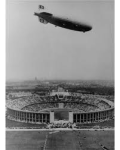
The Olympic Games in Berlin, 1936.
- Germany Versailles Treaty, tears up.png
Germany breaks free from the chains of the Treaty of Versailles, 30 Jan 1937.
- Germany MAN ad 1930s.png
German industry poster advertising heavy trucks.
- German KdF liner Wilhelm Gustloff in colour.png
New KdF liner Wilhelm Gustloff at Hamburg. Launched 5 May 1937.
- German magazine People and Race 1937.png
People and Race magazine, October 1937.
- Bückeberg Harvest Festival.png
Bückeberg Harvest Festival. The 1937 festival was attended by about 1.2 million people.
- German BDM Our flag flutters before us - Ours is the new time.png
BDM poster proclaims "Our flag flutters before us - Ours is the new time!"
- BDM Camp , 1938.png
BDM (League of German Maidens) girls in 1938.
- German HJ Picture.png
Hitler Youth boys cheering.
- German VWs new2.png
The launch of the new Volkswagon (Peoples' car).
- German Autobahn.png
Poster advertising the new Autobahns (Reichsautobahnen) across Germany.
- Germany The Land of Music poster.png
"Germany, The Land of Music".
- Germany Berlin Neuolln Karstadt Dept Store aerial & colour.png
The new Karstadt Dept Store with roof gardens, Neukölln, Berlin. (Destroyed in April 1945)
- Germany Buildings in the New State (1938).png
Professor Troost's 1938 book, Buildings in the New State displaying countless new magnificent structures across the country.
- German new social housing 1938.png
New State social housing.
- German new social housing flats Munich 1938.png
New State social housing: flats in Munich.
- German officers and young men poster.png
Poster encouraging Hitler Youth boys to join the forces.
- Germany 1938-9.png
Map of Greater Germany following the union with Austria, cession of Sudetenland, and assumption of the Protectorate of Bohemia and Moravia 1938-9.
- Adolf Hitler addresses to the Reichstag, 1941.png
The German Chancellor addresses the Reichstag, 1941.


.png)
.png)


.png)
See also
- National Socialist Germany revisionism
- Plebiscites in National Socialist Germany
- German Empire
- Germany
- 1936 Berlin Olympics
- Art in the Third Reich
- Causes of World War II
- World War II
Further reading
- Hitler's Revolution (2013) by Richard Tedor
- Das dritte Reich (1923) by Arthur Moeller van den Bruck:
- Martin Wust: Das Dritte Reich – Ein Versuch über die Grundlagen individueller Kultur, Verlag Wilhelm Braumüller, Wien und Leipzig 1905
External links
- See the article on National Socialism regarding external links specifically on this topic
- How Hitler Tackled Unemployment And Revived Germany’s Economy
- Hitler, the Unemployed and Autarky
- A Prominent German Historian Tackles Taboos of Third Reich History
- Worm in the Apple
- In Defence of Germany
- The Case for Germany. A Study of Modern Germany
- NS Volksschule Plettenberg (1937) - Internet Archive
Article archives
In German
References
- ↑ Woodward, M.A., F.B.A., Prof. E.L., and Butler, M.A., Rohan, Documents on British Foreign Policy 1919-1939 second series, vol.v, 1933, HMSO, London, 1956, p.60.
- ↑ The Reichstag had been set on fire by communists.
- ↑ The Communist Party of Germany (KPD) was again formally banned in West Germany in 1956 by the Constitutional Court.
- ↑ Woodward & Butler, vol.v, 1956, p.46-7.
- ↑ Adolf Hitler, October 14, 1933 Radio Broadcast
- ↑ Per F Dahl (1 January 1999). Heavy Water and the Wartime Race for Nuclear Energy pp. 73– CRC Press. ISBN 978-0-7503-0633-1
- ↑ Chemical Achievers: The Human Face of the Chemical Sciences pp. 76-80 Chemical Heritage Foundation (1997). ISBN 9780941901123
- ↑ Die Olympischen Spiele 1936 in Berlin und Garmisch-Partenkirchen, Band 1, Winterspiele, pubs.Altona-Bahrendfeld, Germany.
- ↑ These youth groups were outlawed by the Allied Control Council on 10 October 1945.
- ↑ https://www.britannica.com/topic/Hindenburg#:~:text=Hindenburg%2C%20German%20dirigible%2C%20the%20largest%20rigid%20airship%20ever,stadium%20in%20Berlin%2C%20Germany%2C%20August%201936.Encyclop%C3%A6dia%20Britannica%2C%20Inc.
- ↑ The Speeches of Adolf Hitler, April 1922-August 1939 edited by Norman H. Baynes, New York, 1969, vol.ii, p.1335-6, address to the Reichstag.
- ↑ Encyclopaedia Britannica Book of the Year 1938, London, 1938, p.354
- ↑ Medlicott, Professor W.N., Dakin, Professor Douglas, Bennett, Gillian, Documents on British Foreign Policy 1919-1939, Second Series, vol.xvii, HMSO London, 1979, p.175.
- ↑ Encyclopaedia Britannica Book of the Year 1938, London, 1938, p.354
- ↑ Nicosia, Francis R., The Third Reich and the Palestine Question, Tauris & Co., London, 1985, p.151-2, ISBN: 1-85043-010-1
- ↑ Great Britain and Palestine 1915-1945, Royal Institute of International Affairs, Information Papers [Book] No.20, London, 1946. p.66-7.
- ↑ Nicosia, 1985, p.163-4.
- ↑ German Documents on Foreign Policy 1918-1945 by an editorial board, Series D, vol.iv, p.482-3.
- ↑ Nicosia, 1985, p.163.